
Pahkahokowin
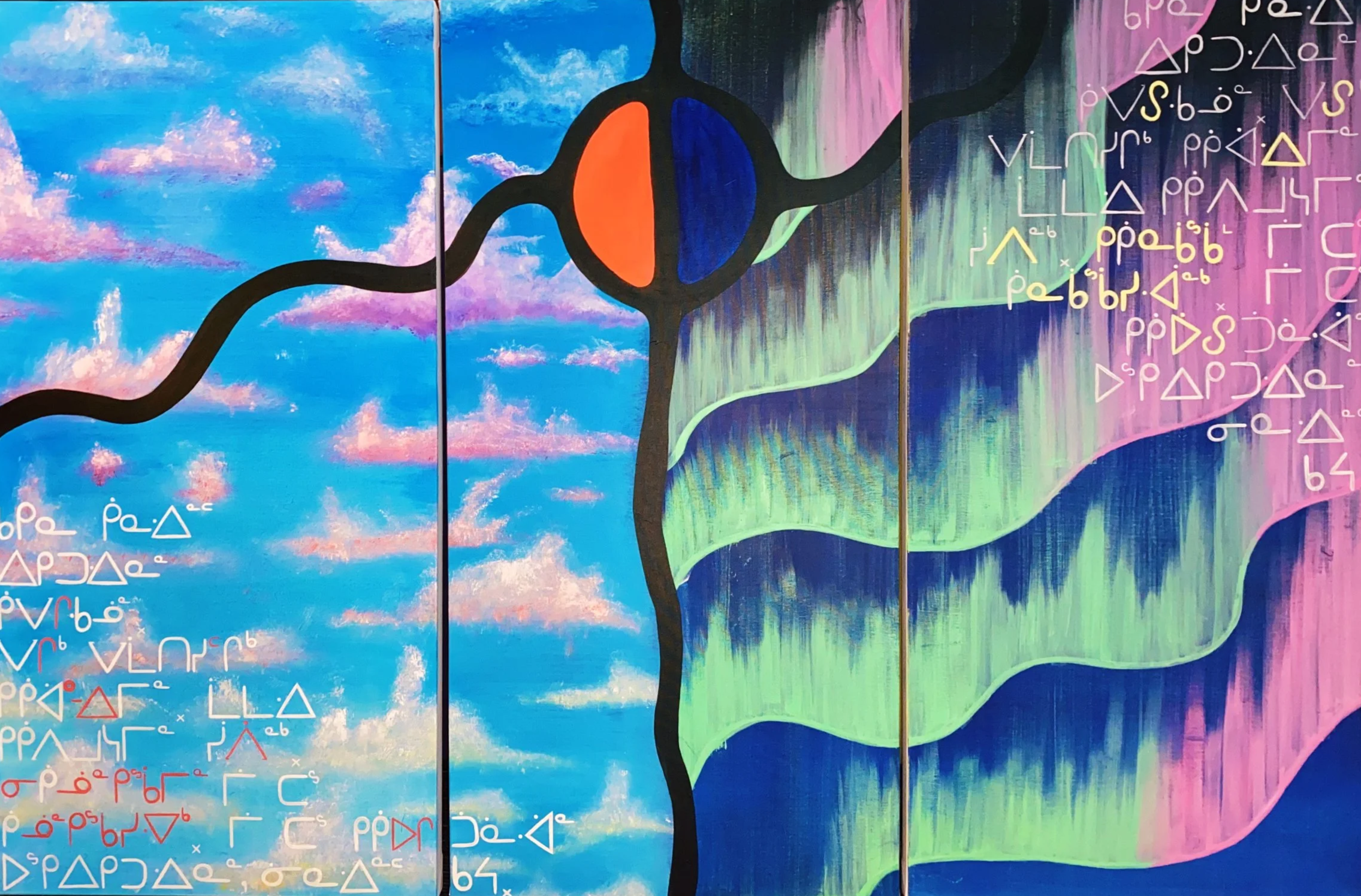
Helen Baillie, Bezhig Anishinaabe. Photo courtesy of the artist.
5th Annual Indigenous Art Exhibition
Angela Wiggins, Brittany Dale, Chayse Davey, Dr. Carleigh Candice Mignonne Milburn, Helen Baillie, Hugo Lussier-Meek, Kiah Seppala, Mikey Brand™, Niiostoseraah Thompson, Nitānis Greyeyes-Brant Barker, Sasha Hill
Curated by Sasza Hinton
Main Space
September 15–October 3, 2026
Opening reception: Saturday, September 12, 1pm-3pm
The Office of Indigenous Initiatives, Agnes, and Union Gallery are thrilled to continue a partnership for the 5th annual Indigenous Art Exhibition at Queen’s University. Programmed in conjunction with the National Day for Truth and Reconciliation, the exhibition is a celebration of Indigenous artists in the Katarokwi area.
This exhibition is generously supported by the Inclusive Community Fund at Queen’s University and the City of Kingston Arts Fund.
CURATORIAL STATEMENT
pahkahokowin
curated by Sasza Hinton
lub-dub… lub-dub… lub-dub… the breeze ripples through the ocean's salty surface, pushing the crests to drum against the earth’s rocky shell. lub-dub… lub-dub… lub-dub… a shallow seismic pulse vibrates below our feet, imperceptible yet constant. lub-dub… lub-dub… lub-dub… the hand drum amplifies her faint beat, our hearts synchronizing with the shared rhythm of the land, water, and sky. lub-dub… lub-dub… lub-dub…
In honour of National Day of Truth and Reconciliation, pahkahokowin bathes the gallery in brilliant colour through the works of Indigenous artists residing in Katarokwi, reflecting on family, community, Indigenous culture, and our interconnected relationships to Mother Earth.
MEET THE CURATOR
Sasza Hinton is an Afro-Indigenous researcher from amiskwacîwâskahikan (Edmonton), Alberta, currently pursuing her PhD in Screen Cultures and Curatorial Studies at Queen’s University. Since completing her BA in Film Studies at the University of Alberta, Sasza’s research has largely focused on media representations of race, gender, and sexuality in contemporary film and television, often highlighting undervalued media forms such as children’s entertainment and puppet-based programming.
As a developing artist and curator, Sasza eagerly approaches local projects and opportunities in Kingston, Ontario, allowing herself to explore diverse roles in university archives and galleries, local theatre, and independent and professional filmmaking. Regardless of form, Sasza’s work continually draws from her own life experiences and affective responses, aiming to connect audiences back with their own memories of childhood, family and community.
MEET THE ARTISTS
Angela Wiggins is an Anishinaabe (Ojibwe) artist whose contemporary painting practice explores identity, relationship, and belonging through gesture, colour, and symbolic form. A bloodline granddaughter of Henry Rufus Trudeau and great-granddaughter of Gabriel Trudeau and Victoria Peltier of Wikwemikong First Nation on Manitoulin Island, her work is informed by family histories of displacement and the enduring impacts of residential schools. Grounded in the principle of Two-Eyed Seeing, Wiggins creates paintings that invite reflection on resilience, connection, and contemporary Indigenous experience. Her work has been presented through solo and juried exhibitions, public art installations, and institutional commissions. In 2026, two of her paintings were acquired for the permanent collection of Crown-Indigenous Relations and Northern Affairs Canada. Wiggins was recognized as a Canada Council for the Arts Professional Indigenous Artist in 2024.
Brittany Dale is a Two-Spirit Queer Disabled Mohawk artist, academic, and advocate whose interdisciplinary practice blends performance, beadwork, and research. Brittany explores stories of survival and joy while confronting the ongoing erasure of Two-Spirit, Trans, and Queer Indigenous peoples. Under the stage name Kopy Cat, Brittany has become a recognized performer in Ontario’s burlesque and cabaret community, using movement and narrative to challenge colonial norms and celebrate queer seduction. Their beadwork practice, rooted in Haudenosaunee tradition and contemporary expression, was featured through a national commission from Hockey Canada for the 2025 World Juniors Championship. Brittany was recently promoted from a master’s degree to a PhD in Cultural Studies with SSHRC funding at Queen’s University. They hold a BA (Honours) in Public Administration and Governance from Toronto Metropolitan University and an advanced diploma from St. Lawrence College’s Musical Theatre Performance program.
Chayse Daveyis a 22 year old Bear Clan Anishinaabe (Odawa/Ojibwe/Potawotami/Moose Cree) visual artist. From Wiikwemkoong Unceded Territory, living in Kingston Ontario. Chayse is a traditional dancer (Men's Traditional) and a graduate of St Lawrence College (2025)
He connects to his Anishinaabe roots through learning the teachings passed down generations and connecting with community at Powwows, Indigenous Festivals, Conferences and Round dances. He enjoys the Mino-Bimaadiziwin (The Good Life) of his Anishinaabe ancestry and lifestyle. Chayse paints in the Woodland School style of art. An art style born from Anishinaabe pictographs and birch bark scrolls. Made mainstream by the late Norval Morrisseau, Daphne Odjig and others.
Dr. Carleigh Candice Mignonne Milburn is a Métis interdisciplinary artist, curator, researcher, and educator whose work explores the intersections of Indigenous knowledge systems, artificial intelligence, decolonization, and research-creation. She is a citizen of the Métis Nation of Ontario and holds a PhD in Cultural Studies from Queen's University, where her doctoral research examined how conventional, digital, and AI-assisted art practices can contribute to decolonial methodologies and ethical approaches to creativity.
Helen Baillie is an Anishinaabe woman from Batchewana First Nation, growing up off reserve near Pikwàkanagàn First Nation. During her formative years, she had the remarkable opportunity to learn the Algonquin language, a language closely related to her own dialect of Anishinaabemowin. There, she acquired knowledge of the culture, the tradition of smudging, the practice of dance and song, painting for storytelling, and the language of her ancestors who tended to the wellbeing of Eshaakamikwe, Mother Earth. Her joyful childhood experiences motivated her to study her own Indigenous language at Algoma University, where she has now graduated Cum Laude with a Bachelor of Arts in Anishinaabemowin and is now pursuing a Bachelor of Education at Queen’s University. Helen paints an Indigenous style called Woodland Art, which is distinctive of her Anishinaabe culture characterized by vibrant colours, representations of Mother Earth's inhabitants, and symbolic lines that convey intricate storytelling.
Aged fourteen, Hugo Lussier-Meek is a proud Michif learner who has graduated grade eight in Kingston, Ontario as of July 2026. In his seventh year, he founded a Beading Circle at his high school to share his love of his Métis culture through beadwork, which he learned from his mum. Passionate about astronomy, he has participated in several science workshops offered by the Queen's University Macdonald Institute, with which he and his family have received a grant to translate scientific knowledge into beadwork pieces and to host a large bead looming workshop for Astroparticle physicists. Upon his eighth grade graduation, he was awarded prizes for artistic engagement, Student Government leadership, and advanced academic standing. He has also, with the help of his Auntie, Liv Rondeau, started a business selling beadwork at local markets and online through his new website.
Kiah Seppala is a third-year Queen’s Commerce student and citizen of the Métis Nation from Sault Ste. Marie, Ontario. Drawing inspiration from her Métis heritage, Northern Ontario, and her community’s history, she creates symbolic works that explore identity, resilience, and cultural continuity. Seppala’s art uplifts the spirit of the Métis Nation and advocates for greater recognition of Métis voices.
Mikey Brand™ is a multi-disciplinary, Ojibwe artist whose work bridges the natural world and the fantastic. Originally from northern Ontario, he studied Animation and Illustration at Oakville's Sheridan College before moving to Toronto. After a lengthy stint in the world of consumer products and corporate advertising where art took a back seat, he relocated to Kingston where he now creates for himself and his clients full time. Inspired by myth, history, animals, music, pop and subcultures, his colourful work has been showcased in many regional galleries as well as on apparel and in books.
Niiostoseraah Jada Thompsonis a Mohawk beadwork artist from Akwesasne Mohawk Territory and a member of the Deer Clan. Her work is rooted in Haudenosaunee teachings, Indigenous adornment, and a deep connection to land, femininity, and storytelling. Through Haudenosaunee raised beadwork, Thompson creates contemporary wearable pieces that honour tradition while reflecting her own perspective as a young Indigenous woman. Drawing from both cultural knowledge and fashion design, her practice explores how adornment can hold beauty, meaning, and memory all at once. Her work often incorporates floral imagery, strawberries, and other elements from the natural world to express love, abundance, softness, and strength. Through her art, Thompson aims to celebrate Indigenous womanhood and create beadwork that feels both culturally grounded and contemporary.
Nitānis Greyeyes-Brant Barker is an Ottawa-based two spirit artist, self-taught beadworker, and undergraduate student from Muskeg Lake Cree Nation in Treaty 6 Territory, Tyendinaga Mohawk Territory, England, and Ireland. They pursued beading at an early age in an effort to strengthen their connection to their ancestors and ground themself in their nations’ vibrant material cultures. Since then, Nitānis has evolved her practice into one which blends traditional Nēhiyaw and Kanyen’kehà:ka teachings with contemporary practices and materials to create pieces that are not only colourful and intricate, but also deeply personal to their experiences as a young First Nations person. Through her beadwork, Nitānis touches upon themes of healing, cultural resistance, identity, relationships, and our connections with the natural world, creating a tangible record of their journeys of personal growth and artistic development.
Sasha Hill is an artist based in Ka’tarokwi/Kingston. She identifies as a mixed race First Nations woman from the Onondaga Nation, her father's side of the family belonging to the Eel Clan with her mother's side of the family coming from a small village across the world from Siberia. Since 2017 Sasha has apprenticed with Joanne Gervais, a master portrait and landscape artist in Kingston. Since then Sasha has worked on many online art courses and workshops led by renowned and award winning portrait artists.