
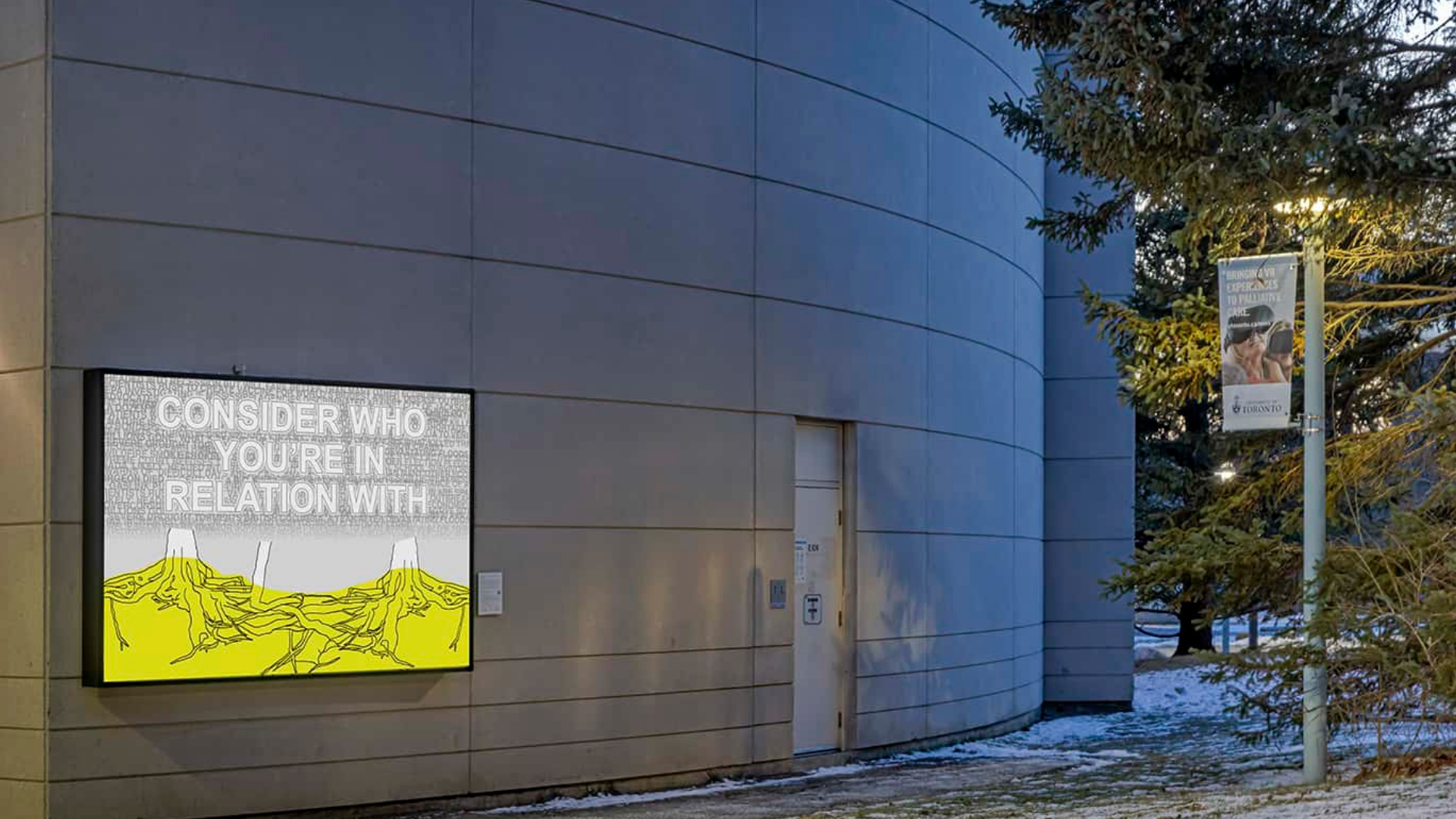
Notes to Self, video still. Christina Battle, 2014, ongoing.
Free + open to all, registration required
Virtual (Zoom)
Tuesdays, 6:00-7:30pm
Making Art Work is a professional development series co-presented by Agnes Etherington Art Centre, Cultivate Art Commons, and Union Gallery. Participants gain enhanced experiential learning opportunities, develop a toolkit of skills in preparing for a career in the arts, and extend networks with Kingston’s contemporary art galleries. Sessions are held primarily online via Zoom on Tuesday evenings.
Some recurring questions guiding this year’s sessions: how do we attend to our needs / the needs of our loved ones / the needs of the planet while sustaining an art practice? How do we adapt to the times we’re living in while upholding our values? How do we honour ourselves and one another in artmaking?
FALL SESSIONS
How Public is Public Art? with Erin Ball and Devon Ostrom
Tuesday 15 September 2026, 6–7:30 pm (ET)
Online via Zoom
Erin Ball (ze/zir), Disabled artist and researcher and Devon Ostrom (he/him), artist and co-researcher with artmap.ca / Access Art, come together to discuss public art and explore how to make more engaging and accessible sites. In this 90-minute workshop, Devon and Erin will show participants a way of evaluating physical, sensory, informational and creative accessibility. They will also share emerging national findings and invite participants to take part in a virtual assessment exercise.
Privacy and Access Needs
This session is online, on Zoom. Auto-generated captions will be turned on for accessibility. Beyond this, we will strive not to use AI for any reason without free and prior consent of all parties involved. There will not be ASL interpretation for this event. If you require additional supports, please let us know while registering. We are striving to co-create a relaxed space where we invite you to come as you are. Camera on or off is welcome, communicate in ways that work for you, take breaks, move around, stim, etc. We will strive to offer content notices around any potentially intense subjects and we will strive to not put anyone on the spot. This presentation will aim to be low-vision friendly, with images and visual descriptions throughout.
Taking Care with Christina Battle
Tuesday 20 October 2026, 6–7:30 pm (ET)
Online via Zoom
Artmaking takes time, labour, finances, and resources, and when faced with the realities of life, especially those that involve caring for others, access to the time needed to develop and maintain an artistic practice can become strained. In this workshop, we’ll spend time thinking through strategies for aligning artistic practice with the realities of one’s life; we’ll ask ourselves what we want to be doing with our (limited) time and how that may, in turn, align the focus of one’s practice. An emphasis on ‘taking care’ will drive our discussion—taking care of others, taking care of ourselves and taking care to consider the potentials of artistic practice.
As part of this workshop, we’ll spend time making postcards to later mail to one another as reminders to take care. Postcard-making packages will be mailed to participants in advance of the workshop—supplies are limited and will take some time to travel to you.
Please note, participants must be based in Canada in order to receive mail-out supply packages. Registration closes on 21 September.
This workshop is made possible by the Iva Speers Fund for Art Education.
Ethical Artists: Exploring Integrity and Consent in the Artmaking Process with Abby Nowakowski
Tuesday 17 November 2026, 6–7:30 pm (ET)
Online via Zoom
In this workshop, Abby Nowakowski will lead us through an open discussion on value-driven practices and the power of bringing your own set of morals into the work you do. We will touch on ways you can work against capitalistic modes of making while still financially sustaining your artistic career, the vital role of radical consent in reciprocal relationships, and how we can fight for creative thinking by avoiding AI and moving towards more human-centred approaches.
We will draft our own code of conduct, which, like all good guidelines, will be a living document that grows and evolves alongside you. It will be a piece of writing that reflects your artistic ethics, that you can return to over and over again. This might be a short poem, a confident statement, or a set of rules that guide you in advocating for yourself and your practice.
Together we will dream up what a truly ethically responsible practice might look like, and imagine a system that could support these new ways of working.