
Artists in the Garden
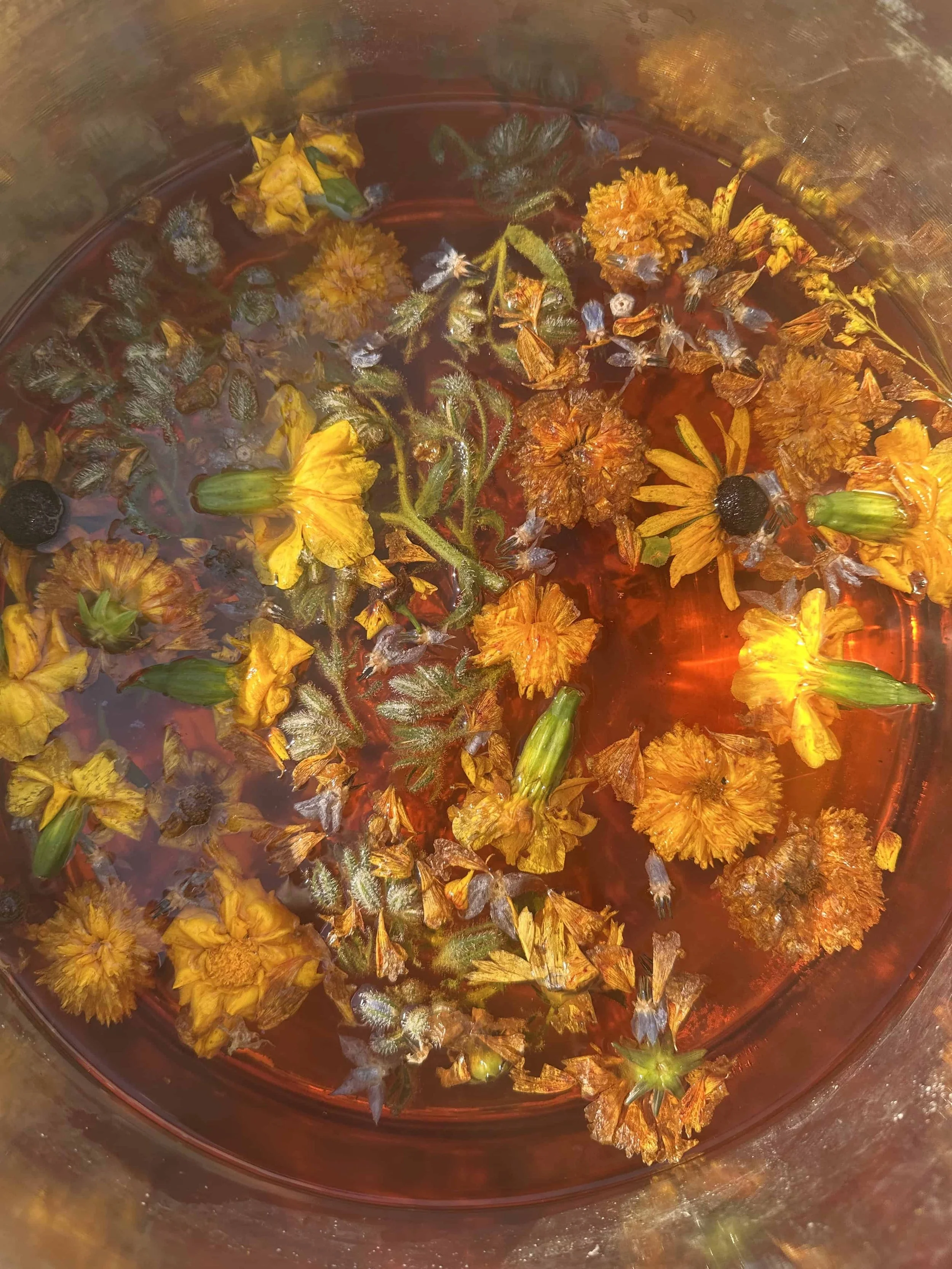
Christina Battle, 2026, Dyeing with Flowers. Image courtesy of the artist.
Jill Glatt + Christina Battle
Feature Wall
September 15–November 21, 2026
Opening reception: Saturday, September 12, 1pm-3pm
CURATORIAL STATEMENT
Artists in the Garden: Seeding Conversation and Parallel Practices
Starting in April, the Artists in the Garden residency has connected Christina Battle and Jill Glatt to grow dye gardens in parallel. Meeting online, across nearly 3,500 kilometres, they shared their motivations as artists working through ongoing intersecting disasters like climate change, colonialism, and fascism. As they got acquainted, they learned that a shared priority was working with plants and the colours they produce. For Christina, this stemmed from a focus on time, seasonal rhythms, and slowing down. For Jill, it meant connecting with old new ways of working to coax colour from the living world, a refusal of petrochemical materials.
Through our discussions, we reflected on how we as artists adapted at the height of the pandemic and the possibilities this challenging period paradoxically made possible: meeting others whose lives were similarly disrupted, having time for meaningful conversations, observing social movements gaining much needed traction and feeling able to participate. We noted how the pressure to resume business as usual at its breakneck speed has impacted life, artistic practice, and the work of making change.
With this unsettled feeling and a sense of shared values, we designed an artist residency for Jill and Christina that would be adaptive to the growing season we were entering into. It would allow them to practice alongside one another, across distance, sharing notes and continuing the open-ended conversation. As these meetings continued, the need for exploration, contemplation, and gathering with others became clear as strategies for coping with and challenging the current state of things. We planted rhubarb, cosmos, safflower, borage, sunflower, amaranth, marigold, and coreopsis.
As our gardens grew, we reflected together on intense climatic patterns we experienced—from Northern Ontario’s wildfires to Edmonton’s heavy rainfalls and chaotic storms. We shared stories of abuses of power, locally and provincially. We talked about the severe El Ninõ expected this year and the destabilizing impacts it would have on seasonal weather patterns to come. At the same time, we sought ways of working with the plants that would replace the need for heavy metals, testing rhubarb leaves and soy milk pretreatments to help the colour bond with the fibres. Jill and Christina shared photos of gardens and dye experiments along the way, and a shared reading list grew (see below) as we wove ideas together.
Joyfully, some of the dye plants had an added benefit: they were edible. Making sweet treats in support of our gatherings infused an extra element of delight that we needed. We shared recipes, making rhubarb squares, crumble, pie, cake, compote, syrup, ice cream, and more. I picked hundreds of tiny wild strawberries ripening in my front yard to make ice cream for a gathering with local folks to take place while Jill led us in ecoprinting with coreopsis blooms. Christina made a variety of treats to share with an intimate group in her dye garden and together, they made sundials and read aloud on the theme of gardens and plants.
This exhibition is a moment of culmination, but not the end. I am grateful to these dear fellow artists for bringing us here, in a moment to contemplate the generosity of plants: their abundant seeds and curious seedpods, their grounding scent, and their delicate silhouettes and dye colours. Christina and Jill invite us also to rest and to dream, to continue their dye experiments and conversations in our own ways, and to embody acts of care, gift giving, and radical imagination so the future can thrive.
— Morgan Wedderspoon, Gallery Director
READING LIST
Rehearsals for Living by Robyn Maynard and Leanne Betosamosake Simpson
Joyful Militancy: Building Thriving Resistance in Toxic Times by Nick Montgomery and carla bergman
Emergent Strategy: Shaping Change, Changing Worlds by adrienne maree brown
Visiting as an Indigenous Feminist Practice by Eve Tuck, Haliehana Stepetin, Rebecca Beaulne-Stuebing & Jo Billows
Natural Connection: Six Roots of Environmental Wisdom and Action by Joycelyn Longdon
Empire of AI: Dreams and Nightmares in Sam Altman’s OpenAI by Karen Hao
Crowd Source by Cecily Nicholson
The Book of Delights by Ross Gay
The Serviceberry: Abundance and Reciprocity in the Natural World by Robin Wall Kimmerer
Hope in the Dark by Rebecca Solnit
Harrowings by Cecily Nicholson
Braiding Sweetgrass: Indigenous Wisdom, Scientific Knowledge, and the Teachings of Plants by Robin Wall Kimmerer
Soil: The Story of a Black Mother’s Garden by Camille T. Dungy
Limiting Overshoot: Navigating exceedance of 1.5°C and pathways toward return by UNEP (United Nations Environment Programme)
ARTIST STATEMENTS
CHRISTINA BATTLE
delayed due to climate change
2026
Series of 14 quilted pillows (organic cotton dyed with plant material, cyanotypes, recycled fabric), video loop (from Notes to Self, 2016).
A summer wrought with wild, unpredictable storms, floods, and personal grief, delayed due to climate change, was made as a way to help mark the time. Waiting for flowers to bloom in order to prepare dyed fabric meant grappling with the reality of ‘delay,’ and all of the worry, sadness, and unknown that it can foster. delayed due to climate change centres joy and beauty as necessary through it all and considers the ways that slowness can offer a delicate reprieve. It’s been a tough summer, and the ordered, careful process of sewing soft and pillowy forms offered some relief. Really, I didn’t know what else to do.
the smell of summer
2026
Series of 50 scent sachets (organic cotton dyed with plant material and dried sweetgrass, gathered summer 2026).
An attempt to share the beautiful summery smell of sweetgrass with as many people as possible. Each sachet is meant as a reminder of summer 2026 to carry forward into the future.
JILL GLATT
Disseminate
2026
Series of 3 fabric sculptures (reclaimed cotton dyed with plant material)
Carry
2026
Reclaimed cotton dyed with plant material, dried marigold flowers
Vessels
2026
Organic cotton dyed with plant material
This series of new work centres radical imagination and physically manifests it as seeds and seed-storing vessels. Seeds are a world unto themselves—stored potential that can grow beautifully under the right conditions. Similarly, in the words of environmental justice technologist and writer Joycelyn Longdon, “we bring the worlds we imagine into being”. If our imagined futures are the seeds, then we are the vessels that hold these seeds until they are ready to be planted. The process of making these artworks has been slow, experimental, and rife with surprises, serving as a reminder to myself that working towards a better, livable future will be the same as well.
ABOUT THE ARTISTS
Christina Battle is an artist, curator, and writer based in amiskwacîwâskahikan (Edmonton), within the Aspen Parkland: the transition zone where prairie and forest meet. Her practice focuses on thinking deeply about the concept of disaster: its complexity, and the intricacies entwined within it. She looks to disaster as a series of intersecting processes including social, environmental, cultural, political, and economic, which are implicated not only in how disaster is caused but also in how it manifests, is responded to, and overcome. Battle’s practice prioritizes collaboration, experimentation, and failure; she has exhibited internationally in festivals and galleries as both artist and curator.
Jill Glatt is a Katarokwi/Kingston-based natural dyer, printmaker, and arts educator. Her artistic practice is informed by ecology, community, and sustainability. Glatt incorporates studies of native and non-native plants and their dyes to draw attention to social and environmental issues, often with a focus on the Katarokwi River. She centres collaboration with other artists and community members, and has most recently taken part in the Agnes Etherington Art Centre’s HEAP (Humus Emergence Assemblage Platform) collaborative micro-residency.
THANKS + ACKNOWLEDGEMENTS
This exhibition is supported by the George Taylor Richardson Memorial Fund at Queen’s University.
Community Project + Artist Residency
Gallery Garden + remote locations
Summer 2026
Public Program: Tuesday, July 14, 6pm @ Union Gallery
Artists in the Garden is Union Gallery’s collectively-led, collaborative garden project where artists work together to plant, grow, tend to, and harvest plants for their artistic practices and creative pursuits. This program began in 2024 as a small collective of local artists creating and cultivating in a small garden plot just outside Union Gallery; in 2025, the garden plot was tended on a casual, drop-in basis by artists, UG staff, and community volunteers. This year, Artists in the Garden will feature two artists in residence, Jill Glatt (Katarokwi/Kingston) and Christina Battle (amiskwacîwâskahikan/Edmonton), who will work together over a 3,500+km distance, culminating in a duo exhibition at Union Gallery in Fall 2026.
Stay tuned for more information about public programs in response to harvesting timelines, including events onsite at UG’s Gallery Garden, at Oak Street Community Gardens (Katarokwi/Kingston), and opportunities for remote involvement and collaboration.